
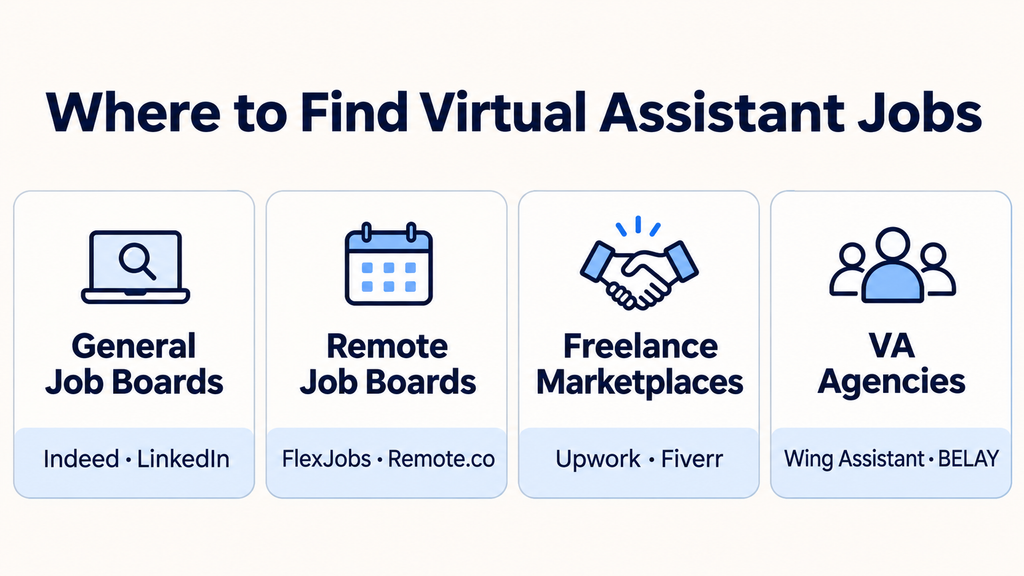
The best places to find virtual assistant jobs are general boards (Indeed, LinkedIn, ZipRecruiter), remote-first boards (FlexJobs, We Work Remotely, Remote.co), freelance marketplaces (Upwork, Fiverr), and VA agencies (Wing Assistant, BELAY, Time Etc, Fancy Hands). The process has three steps. Pick two or three services you can already do, check each listing for legitimacy, location and contract terms, then apply with work samples.
At SolomonSolution, our researched remote job board directory compares boards by role focus, access cost and location guidance, and links out to the original listings. We also offer skill paths and portfolio guidance, so you can prove you can do the work. Listings change quickly, so vet each one before you apply.
Key takeaways
- Mix source types: Use at least one general board, one remote-first board and one freelance or agency option.
- Narrow your services: Two or three clear services beat “I can do everything.”
- Vet every listing: Confirm the post is live, find the official careers page, and check location and contract type.
- Read “remote” carefully: Many openings are restricted to U.S. residents or even a single state.
- Know the pay band: Rates vary by experience, specialty and whether you’re an employee or contractor.
Which job boards and employers list virtual assistant jobs right now?
Real openings exist today across several kinds of boards. Haystack reported 67 live virtual assistant jobs from 17 employers in its November 21, 2026 update. The key is knowing which source fits your situation.
General boards versus remote-first boards
Indeed, LinkedIn Jobs and ZipRecruiter cover remote administrative and executive assistant roles across industries. FlexJobs, We Work Remotely and Remote.co are curated for remote work.
Recent examples show what’s out there. Talentoma has a fully remote virtual assistant specialist role covering inbox, calendar, correspondence and task management. DLN Consulting Group lists remote VA positions, and Jobgether has several nationwide U.S. listings. Openings like these can close quickly, so check the original posting before you plan around any of them.
Where to look and what each is best for
| Source type | Examples | Best for | Watch out for |
| General job boards | Indeed, LinkedIn Jobs, ZipRecruiter | Employer-posted admin and executive assistant roles | Reposted or expired listings |
| Remote-first boards | FlexJobs, We Work Remotely, Remote.co | Curated remote, part-time and contract roles | Subscription fees (FlexJobs) |
| Freelance marketplaces | Upwork, Fiverr | Small projects and first reviews | Platform fees, contractor terms |
| VA agencies | Wing Assistant, BELAY, Time Etc, Fancy Hands, Prialto | Structured or recurring work | Eligibility and state restrictions |
| Direct outreach | Coaches, real estate pros, small shops | Direct clients and retainers | You handle pitching and contracts |
| SolomonSolution directory | Researched boards by role | Choosing where to search, with links to original listings and employer career sites | Always confirm the live posting on the original site |
Best routes for entry-level, part-time and freelance virtual assistant jobs
For entry-level virtual assistant jobs and part-time work, search Indeed and ZipRecruiter for “entry-level virtual assistant” and “part-time remote administrative assistant.” Task-based work like Fancy Hands is a low-risk way to gain experience. For freelance virtual assistant jobs, start with small Upwork projects or Fiverr service packages to collect reviews.
Also join VA communities on LinkedIn and Facebook for referrals and leads. Pitch coaches, real estate professionals and small shops directly with a short note about the tasks you handle.
What do virtual assistants actually do, and which skills do employers want?
Virtual assistants handle the admin work that keeps a business moving: inbox and calendar management, scheduling, data entry, research, customer support and document formatting. Specialty versions include social media, bookkeeping, CRM and systems work, healthcare or real estate coordination, and executive assistant roles.
Job posts repeat the same skills:
- Written communication
- Organization and time management
- Attention to detail
- Independent problem-solving
- Discretion with confidential information
- Async remote work habits
Many entry-level roles don’t require a degree. Employers look for reliability, tool fluency and evidence of finished work.
Learn the tools first. The baseline is Google Workspace or Microsoft 365, Slack, Teams or Zoom, a project tool like Asana, Trello or Notion, and a CRM such as HubSpot. Canva and light automation tools like Zapier help for content and operations roles. Our comparison of 34 tools includes free-plan limits, so you can practice on free tiers before you apply.
How do you build virtual assistant work samples with no client experience?
You build them with clearly labeled practice projects that show what you can do. Start with two or three services you already deliver, such as email management, scheduling, spreadsheets, research or customer support. A narrow focus tells an employer exactly what to hire you for, while a vague profile makes them guess.
Practice tasks that become portfolio pieces
Pick tasks that mirror real work:
- Clean up a fictional inbox with labeling rules and draft replies.
- Build a travel itinerary and calendar plan.
- Create a researched comparison spreadsheet.
- Draft customer support replies.
Volunteering for a nonprofit or small business can give you a chance to ask for a reference. Define the task and timeframe up front so it doesn’t turn into free labor.
Package your samples so employers can follow them
For each sample, show the tools used, the task handled, the time saved or volume where possible, and a short “how I did it” note. Label every piece honestly as a practice project. Our 24 skill paths come with role-relevant practice tasks, and our guides on building a portfolio without client experience and practicing virtual assistant work are a good place to start.
How can you tell if a virtual assistant listing is legitimate and open to you?
Verify the employer, read the location terms, and check the hours. Scams share clear patterns: upfront fees, bank details requested before an interview, unusually large unpaid test work, vague company details, and messages that push you off-platform.
Verify the employer and the original listing
Confirm the posting is still active, then find the company’s official careers page and apply there when possible. That’s why our directory links to original listings and employer sites. Follow this checklist:
- Type the company’s web address yourself and find the same role on its careers page.
- Check that the recruiter exists on LinkedIn and that their email domain matches the company’s.
- Search the company name plus “scam” and “review.”
- Get duties, pay, hours, payment method and employment classification in writing.
- Stop if anyone asks you to pay for equipment or training, or sends an unexpected check and asks you to deposit it and send money back. Don’t deposit or act on a check you didn’t expect until you’ve verified the employer independently.
Is “remote” really open where you live?
Not always, since many openings are U.S.-only or nationwide U.S., and some are state-specific, like a Texas-only travel and tourism role. City names in titles such as Detroit, Dallas or DFW don’t necessarily mean local-only hiring. The Jobgether listings carrying those names are open nationwide in the U.S.
Read residency language closely. The Talentoma listing is U.S.-only but also mentions working from home in North Carolina, so confirm whether residency there is required. Employers restrict by payroll, tax, licensing and regulation. If you’re outside the U.S., worldwide boards like Remote Nomad Jobs exist for you.
Time zone overlap
Check the required hours before you apply. Language like “must be available during U.S. business hours” signals the employer expects overlap, but it rarely says how much. In your first message, confirm the time zone, the exact start and end times, and whether the schedule shifts with daylight saving time. A quick question such as “Which hours do you need me online each day, and in which time zone?” settles it before either side invests more time.
Employee or contractor: what will you actually earn?
Employees get steadier hours and possible benefits, but lower stated pay. According to There Is Talent, average pay for U.S. Contractors charge more but cover their own taxes, insurance and unpaid time. Look for the contract type in the listing and ask if it’s unclear. If you’re outside major hiring markets, contractor terms are common, so check the payment method and tax implications.
International rates run lower in many regions. Still, rates track the client’s market and budget more than the VA’s location.
What pushes your rate up
Direct clients generally pay more than platforms, which can take fees. Niche credentials in CRM, bookkeeping, or medical and legal systems raise rates. Retainers and project pricing can also beat hourly billing.
Your next step toward landing a virtual assistant job
Here’s the sequence. Choose your services, build two or three work samples, and search the right boards. Vet each listing for scams, location, time zone and contract type, then apply through the employer’s official page. Whether you want freelance work or a steady employee role, the same steps apply to virtual assistant jobs at every level.
Start with SolomonSolution: the job board directory shows where to search, our skill paths give you practice, and our portfolio guidance gives you proof. Pick one board and one practice task today, and finish both this week.
Frequently Asked Questions
Do you need a degree to become a virtual assistant?
You don’t need a degree for many entry-level virtual assistant roles. Employers look for reliability, tool fluency and evidence of finished work.
How can you get your first virtual assistant client?
You can pitch coaches, real estate professionals and small shops directly with a short note about the tasks you handle. You can also start with small Upwork projects or Fiverr service packages to collect reviews.
Can you find virtual assistant jobs outside the United States?
Yes, you can search worldwide boards such as Remote Nomad Jobs. Check each listing’s residency requirements, payment method and contract terms before applying.
What should you ask about a virtual assistant’s schedule before applying?
You should confirm the time zone, exact start and end times, and whether the schedule shifts with daylight saving time. A listing may require availability during U.S. business hours without specifying how much overlap is needed.